
Erectile dysfunction in your 30s can feel like a sexual problem.
Sometimes it is.
But sometimes your body may be telling you something much bigger.
Research has found that erectile dysfunction, particularly when caused by blood-flow problems, can appear several years before obvious cardiovascular disease. Reviews have reported that ED may precede cardiovascular events by roughly three to five years in some men.
That does not mean every man with ED is headed for a heart attack.
It does mean persistent erectile problems deserve more attention than simply finding a pill that temporarily fixes the symptom.
Your erections depend heavily on healthy blood vessels. So does your heart.
And problems with one can sometimes give you an early clue about the other.
Why Erectile Dysfunction Can Show Up Before Heart Problems
An erection is largely a blood-flow event.
When you’re sexually stimulated, blood vessels supplying the penis need to relax and expand so blood can enter the erectile tissue.
That process depends partly on a healthy layer inside your blood vessels called the endothelium.
The endothelium helps regulate blood-vessel relaxation and blood flow throughout the body.
When it isn’t working properly, a condition known as endothelial dysfunction, blood flow may become impaired.
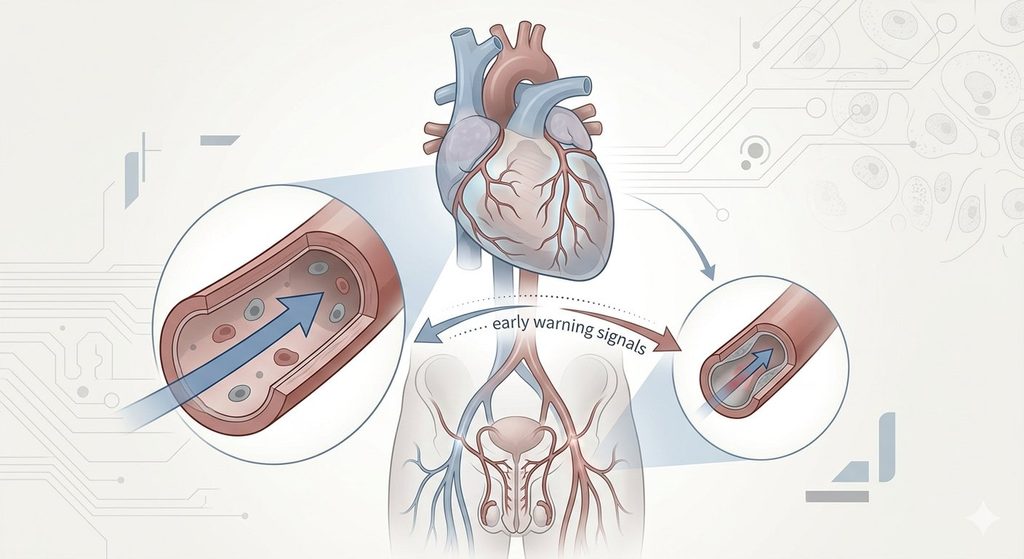
And the blood vessels supplying the penis are particularly small.
Penile arteries are roughly 1 to 2 millimeters in diameter, while coronary arteries supplying the heart are larger. Because of that size difference, vascular problems may become noticeable in the penis before they create obvious symptoms in the heart.
Think of it like plumbing.
If the same buildup is affecting several pipes, the narrowest pipe may begin having problems first.
That is one reason ED can sometimes be an early warning sign rather than an isolated sexual problem.
Is Erectile Dysfunction Normal in Your 30s?
An occasional problem maintaining an erection isn’t unusual.
Stress, exhaustion, alcohol, relationship problems, anxiety, medications, or simply having a rough week can interfere with sexual performance.
Persistent ED is different.
Erectile dysfunction can occur in younger men, and research shows that both psychological and physical factors can contribute. A review of ED in men under 40 found potential causes ranging from anxiety and depression to vascular, hormonal, neurological, and medication-related problems.
The mistake is assuming:
“I’m only 32, so this can’t be a physical problem.”
Age lowers your overall cardiovascular risk compared with someone in his 60s, but it doesn’t make you immune to high blood pressure, abnormal cholesterol, insulin resistance, obesity, nicotine exposure, or other problems affecting blood vessels.
In fact, cardiovascular and metabolic risk factors may be especially important to investigate in younger men with unexplained ED.
Five Overlooked Causes of ED in Younger Men
Many men immediately assume ED means low testosterone.
That’s only one possibility.
Several other factors deserve attention.
1. Chronic Stress
Your sexual response involves your brain, nervous system, hormones, emotions, and blood vessels.
High stress and performance anxiety can interfere with that process.
Stress can either cause erectile problems directly or make an existing physical problem worse.
2. Poor Sleep
Consistently poor sleep can affect hormones, mood, blood pressure, metabolism, and sexual function.
Certain sleep disorders are also associated with erectile dysfunction.
Someone working long hours, sleeping five hours a night, drinking heavily on weekends, and living on caffeine shouldn’t automatically assume his ED is mysterious.
His lifestyle may be contributing.
3. Smoking, Nicotine, and Vaping
Cigarette smoking is a known risk factor for both cardiovascular disease and erectile dysfunction.
Vaping shouldn’t automatically be considered harmless either.
A large U.S. observational study found an association between electronic nicotine-delivery-system use and erectile dysfunction, although an observational study cannot prove that vaping directly caused the ED.
For men trying to protect vascular health, getting away from nicotine altogether is the safer direction.
4. Sitting All Day
Your desk job may not feel dangerous, but physical inactivity is associated with erectile dysfunction and broader cardiovascular risk.
The National Institute of Diabetes and Digestive and Kidney Diseases lists inadequate physical activity among lifestyle behaviors that may contribute to ED.
Sitting for ten hours and exercising for zero isn’t a great combination for blood-vessel health.
5. Blood Sugar Problems
Diabetes is strongly associated with ED because elevated blood sugar can damage both nerves and blood vessels.
And these problems don’t suddenly appear the day someone receives a diabetes diagnosis.
Insulin resistance and abnormal blood sugar can develop gradually.
That’s why checking an A1C or fasting glucose level can be useful when persistent ED appears without an obvious explanation.
Psychological ED vs. Vascular ED
This isn’t always a clean either-or diagnosis.
Physical problems can create anxiety.
Anxiety can then make the physical problem worse.
Still, certain patterns may give your doctor useful clues.
Psychological or situational ED may appear suddenly and occur only under particular circumstances. A man might struggle with a partner but still experience strong spontaneous or self-stimulated erections.
Physical ED often develops more gradually and may occur across different situations.
Morning erections can also provide information.
Regular morning erections suggest that the nerves and blood-flow mechanisms required for erections are capable of functioning.
A persistent disappearance of spontaneous or morning erections may provide another reason to investigate physical causes.
But don’t try to diagnose yourself using this test alone.
ED is often caused by several overlapping factors, not one simple problem.
The Heart Disease Connection
Erectile dysfunction and cardiovascular disease share many of the same risk factors:
- High blood pressure
- Diabetes
- High cholesterol
- Smoking
- Obesity
- Physical inactivity
- Metabolic syndrome
They also share one important biological problem: endothelial dysfunction.
Research examining men with ED has found signs of poorer vascular function compared with men without ED. One systematic review and meta-analysis found ED was associated with measures of subclinical cardiovascular disease, including impaired flow-mediated dilation of blood vessels.
The American College of Cardiology highlighted the 2024 Princeton IV Consensus Guidelines, which recommend considering vasculogenic ED a cardiovascular risk-enhancing factor when evaluating men for atherosclerotic cardiovascular disease.
That changes how ED should be viewed.
The goal isn’t to panic.
The goal is to ask:
Why is this happening?
Don’t Just Treat the Symptom
ED medications can be extremely useful when prescribed appropriately.
But medication doesn’t answer the underlying question.
If you’re 35 years old and suddenly experiencing persistent ED, simply obtaining medication online without investigating your health may mean missing useful information.
Talk with your healthcare professional about whether you should check things such as:
Blood pressure
High blood pressure can damage blood vessels over time and frequently produces no obvious symptoms.
Cholesterol and triglycerides
A lipid panel can reveal cardiovascular risk factors you may not know you have.
A1C or fasting glucose
These tests can identify diabetes or abnormal blood-sugar regulation.
Weight and waist circumference
Excess abdominal fat is associated with insulin resistance and cardiovascular risk.
Medication history
Some antidepressants, blood-pressure medications, and other drugs may affect sexual function.
Hormone testing when appropriate
Low testosterone can contribute to sexual problems, but it shouldn’t automatically be assumed to be the cause.
Earlier clinical guidance on ED and cardiovascular risk has recommended medical assessment, including blood pressure, glucose, and lipid evaluation, rather than looking at ED purely as a sexual symptom.
Related article opportunity: Low Testosterone After 30: Signs, Causes, and When to Get Tested
Related article opportunity: Heart Disease in Men: The Warning Signs You Shouldn’t Ignore
Four Lifestyle Changes That Help Your Heart and Your Erections
Here’s the encouraging part.
Many of the things that improve cardiovascular health also support erectile function.
Exercise Regularly
You don’t need to become a marathon runner.
Start with consistent walking, resistance training, and other activities you can maintain.
Regular movement supports circulation, weight control, blood-pressure management, and metabolic health.
Stop Smoking and Nicotine Use
Your blood vessels need to expand properly for erections.
Nicotine and tobacco work against healthy vascular function.
Quitting benefits far more than your sex life.
Lose Excess Weight
If you’re overweight, even moderate weight loss may improve several factors connected with ED, including blood pressure, insulin sensitivity, and cardiovascular health.
The objective isn’t chasing a perfect body.
It’s improving metabolic health.
Take Sleep Seriously
Sleep isn’t wasted time.
Consistently poor sleep can affect energy, hormones, stress, metabolism, and sexual function.
Seven hours of quality sleep will usually do more for your health than another hour scrolling on your phone at midnight.
When Should You Actually See a Doctor?
One unsuccessful night isn’t ED.
Neither is occasionally struggling after too much alcohol, severe stress, illness, or very little sleep.
Look at the pattern instead.
Consider scheduling a medical evaluation if:
- Erectile problems are happening repeatedly.
- The problem continues for several weeks or longer.
- Erections have gradually become weaker.
- Morning or spontaneous erections have noticeably decreased.
- You also have high blood pressure, obesity, high cholesterol, or diabetes.
- You smoke or regularly use nicotine.
- You have a strong family history of premature heart disease.
- Your sexual desire has also changed significantly.
- ED is creating significant anxiety or relationship problems.
Seek urgent medical care for symptoms such as chest pressure, severe shortness of breath, fainting, or other possible signs of a cardiovascular emergency.
ED in Your 30s Isn’t Something to Ignore or Panic About
Erectile dysfunction isn’t a diagnosis of heart disease.
But persistent ED may be information.
And information is useful.
Instead of seeing ED only as something embarrassing that needs to be hidden or temporarily fixed, use it as an opportunity to look at the bigger picture.
Check your blood pressure.
Know your cholesterol.
Know your blood sugar.
Exercise.
Sleep properly.
Stop smoking or vaping.
And if the problem keeps happening, talk with your healthcare professional.
Finding a cardiovascular risk factor at 35 isn’t bad news.
Ignoring it for another 20 years might be.
The real message isn’t that erectile dysfunction means something terrible is about to happen.
It’s that your body may be giving you an opportunity to take control of your health before bigger problems develop.
This article is for educational purposes and is not a substitute for medical diagnosis or individualized treatment. Persistent erectile dysfunction should be discussed with a qualified healthcare professional. le dysfunction in your 30s can feel like a sexual problem.
Sometimes it is.
But sometimes your body may be telling you something much bigger.
Research has found that erectile dysfunction, particularly when caused by blood-flow problems, can appear several years before obvious cardiovascular disease. Reviews have reported that ED may precede cardiovascular events by roughly three to five years in some men.
That does not mean every man with ED is headed for a heart attack.
It does mean persistent erectile problems deserve more attention than simply finding a pill that temporarily fixes the symptom.
Your erections depend heavily on healthy blood vessels. So does your heart.
And problems with one can sometimes give you an early clue about the other.
Why Erectile Dysfunction Can Show Up Before Heart Problems
An erection is largely a blood-flow event.
When you’re sexually stimulated, blood vessels supplying the penis need to relax and expand so blood can enter the erectile tissue.
That process depends partly on a healthy layer inside your blood vessels called the endothelium.
The endothelium helps regulate blood-vessel relaxation and blood flow throughout the body.
When it isn’t working properly—a condition known as endothelial dysfunction—blood flow may become impaired.
And the blood vessels supplying the penis are particularly small.
Penile arteries are roughly 1 to 2 millimeters in diameter, while coronary arteries supplying the heart are larger. Because of that size difference, vascular problems may become noticeable in the penis before they create obvious symptoms in the heart.
Think of it like plumbing.
If the same buildup is affecting several pipes, the narrowest pipe may begin having problems first.
That is one reason ED can sometimes be an early warning sign rather than an isolated sexual problem.
Is Erectile Dysfunction Normal in Your 30s?

An occasional problem maintaining an erection isn’t unusual.
Stress, exhaustion, alcohol, relationship problems, anxiety, medications, or simply having a rough week can interfere with sexual performance.
Persistent ED is different.
Erectile dysfunction can occur in younger men, and research shows that both psychological and physical factors can contribute. A review of ED in men under 40 found potential causes ranging from anxiety and depression to vascular, hormonal, neurological, and medication-related problems.
The mistake is assuming:
“I’m only 32, so this can’t be a physical problem.”
Age lowers your overall cardiovascular risk compared with someone in his 60s, but it doesn’t make you immune to high blood pressure, abnormal cholesterol, insulin resistance, obesity, nicotine exposure, or other problems affecting blood vessels.
In fact, cardiovascular and metabolic risk factors may be especially important to investigate in younger men with unexplained ED.
Five Overlooked Causes of ED in Younger Men
Many men immediately assume ED means low testosterone.
That’s only one possibility.
Several other factors deserve attention.
1. Chronic Stress
Your sexual response involves your brain, nervous system, hormones, emotions, and blood vessels.
High stress and performance anxiety can interfere with that process.
Stress can either cause erectile problems directly or make an existing physical problem worse.
2. Poor Sleep
Consistently poor sleep can affect hormones, mood, blood pressure, metabolism, and sexual function.
Certain sleep disorders are also associated with erectile dysfunction.
Someone working long hours, sleeping five hours a night, drinking heavily on weekends, and living on caffeine shouldn’t automatically assume his ED is mysterious.
His lifestyle may be contributing.
3. Smoking, Nicotine, and Vaping
Cigarette smoking is a known risk factor for both cardiovascular disease and erectile dysfunction.
Vaping shouldn’t automatically be considered harmless either.
A large U.S. observational study found an association between electronic nicotine-delivery-system use and erectile dysfunction, although an observational study cannot prove that vaping directly caused the ED.
For men trying to protect vascular health, getting away from nicotine altogether is the safer direction.
4. Sitting All Day
Your desk job may not feel dangerous, but physical inactivity is associated with erectile dysfunction and broader cardiovascular risk.
The National Institute of Diabetes and Digestive and Kidney Diseases lists inadequate physical activity among lifestyle behaviors that may contribute to ED.
Sitting for ten hours and exercising for zero isn’t a great combination for blood-vessel health.
5. Blood Sugar Problems
Diabetes is strongly associated with ED because elevated blood sugar can damage both nerves and blood vessels.
And these problems don’t suddenly appear the day someone receives a diabetes diagnosis.
Insulin resistance and abnormal blood sugar can develop gradually.
That’s why checking an A1C or fasting glucose level can be useful when persistent ED appears without an obvious explanation.
Psychological ED vs. Vascular ED
This isn’t always a clean either-or diagnosis.
Physical problems can create anxiety.
Anxiety can then make the physical problem worse.
Still, certain patterns may give your doctor useful clues.
Psychological or situational ED may appear suddenly and occur only under particular circumstances. A man might struggle with a partner but still experience strong spontaneous or self-stimulated erections.
Physical ED often develops more gradually and may occur across different situations.
Morning erections can also provide information.
Regular morning erections suggest that the nerves and blood-flow mechanisms required for erections are capable of functioning.
A persistent disappearance of spontaneous or morning erections may provide another reason to investigate physical causes.
But don’t try to diagnose yourself using this test alone.
ED is often caused by several overlapping factors, not one simple problem.
The Heart Disease Connection
Erectile dysfunction and cardiovascular disease share many of the same risk factors:
- High blood pressure
- Diabetes
- High cholesterol
- Smoking
- Obesity
- Physical inactivity
- Metabolic syndrome
They also share one important biological problem: endothelial dysfunction.
Research examining men with ED has found signs of poorer vascular function compared with men without ED. One systematic review and meta-analysis found ED was associated with measures of subclinical cardiovascular disease, including impaired flow-mediated dilation of blood vessels.
The American College of Cardiology highlighted the 2024 Princeton IV Consensus Guidelines, which recommend considering vasculogenic ED a cardiovascular risk-enhancing factor when evaluating men for atherosclerotic cardiovascular disease.
That changes how ED should be viewed.
The goal isn’t to panic.
The goal is to ask:
Why is this happening?
Don’t Just Treat the Symptom
ED medications can be extremely useful when prescribed appropriately.
But medication doesn’t answer the underlying question.
If you’re 35 years old and suddenly experiencing persistent ED, simply obtaining medication online without investigating your health may mean missing useful information.
Talk with your healthcare professional about whether you should check things such as:
Blood pressure
High blood pressure can damage blood vessels over time and frequently produces no obvious symptoms.
Cholesterol and triglycerides
A lipid panel can reveal cardiovascular risk factors you may not know you have.
A1C or fasting glucose
These tests can identify diabetes or abnormal blood-sugar regulation.
Weight and waist circumference
Excess abdominal fat is associated with insulin resistance and cardiovascular risk.
Medication history
Some antidepressants, blood-pressure medications, and other drugs may affect sexual function.
Hormone testing when appropriate
Low testosterone can contribute to sexual problems, but it shouldn’t automatically be assumed to be the cause.
Earlier clinical guidance on ED and cardiovascular risk has recommended medical assessment, including blood pressure, glucose and lipid evaluation, rather than looking at ED purely as a sexual symptom.
Related article opportunity: Low Testosterone After 30: Signs, Causes, and When to Get Tested
Related article opportunity: Heart Disease in Men: The Warning Signs You Shouldn’t Ignore
Four Lifestyle Changes That Help Your Heart and Your Erections
Here’s the encouraging part.
Many of the things that improve cardiovascular health also support erectile function.
Exercise Regularly
You don’t need to become a marathon runner.
Start with consistent walking, resistance training, and other activity you can maintain.
Regular movement supports circulation, weight control, blood-pressure management, and metabolic health.
Stop Smoking and Nicotine Use
Your blood vessels need to expand properly for erections.
Nicotine and tobacco work against healthy vascular function.
Quitting benefits far more than your sex life.
Lose Excess Weight
If you’re overweight, even moderate weight loss may improve several factors connected with ED, including blood pressure, insulin sensitivity, and cardiovascular health.
The objective isn’t chasing a perfect body.
It’s improving metabolic health.
Take Sleep Seriously
Sleep isn’t wasted time.
Consistently poor sleep can affect energy, hormones, stress, metabolism, and sexual function.
Seven hours of quality sleep will usually do more for your health than another hour scrolling on your phone at midnight.
When Should You Actually See a Doctor?

One unsuccessful night isn’t ED.
Neither is occasionally struggling after too much alcohol, severe stress, illness, or very little sleep.
Look at the pattern instead.
Consider scheduling a medical evaluation if:
- Erectile problems are happening repeatedly.
- The problem continues for several weeks or longer.
- Erections have gradually become weaker.
- Morning or spontaneous erections have noticeably decreased.
- You also have high blood pressure, obesity, high cholesterol, or diabetes.
- You smoke or regularly use nicotine.
- You have a strong family history of premature heart disease.
- Your sexual desire has also changed significantly.
- ED is creating significant anxiety or relationship problems.
Seek urgent medical care for symptoms such as chest pressure, severe shortness of breath, fainting, or other possible signs of a cardiovascular emergency.
ED in Your 30s Isn’t Something to Ignore—or Panic About
Erectile dysfunction isn’t a diagnosis of heart disease.
But persistent ED may be information.
And information is useful.
Instead of seeing ED only as something embarrassing that needs to be hidden or temporarily fixed, use it as an opportunity to look at the bigger picture.
Check your blood pressure.
Know your cholesterol.
Know your blood sugar.
Exercise.
Sleep properly.
Stop smoking or vaping.
And if the problem keeps happening, talk with your healthcare professional.
Finding a cardiovascular risk factor at 35 isn’t bad news.
Ignoring it for another 20 years might be.
The real message isn’t that erectile dysfunction means something terrible is about to happen.
It’s that your body may be giving you an opportunity to take control of your health before bigger problems develop.
This article is for educational purposes and is not a substitute for medical diagnosis or individualized treatment. Persistent erectile dysfunction should be discussed with a qualified healthcare professional. should be discussed with a qualified healthcare professional.