
You may think a growing waistline and falling testosterone are simply two separate parts of getting older.
They are not necessarily separate.
Research increasingly suggests that where a man stores body fat, especially deep inside the abdomen, may have an important relationship with testosterone levels.
For men over 40, this matters because declining energy, reduced muscle, stubborn belly fat, lower sex drive, and poor motivation are often blamed entirely on age.
But age may not tell the whole story.
A major 2026 study found that men carrying higher amounts of visceral fat, the deeper abdominal fat surrounding the organs, had significantly lower testosterone than men with less visceral fat, even when their body mass index was similar.
That changes the conversation.
The problem may not simply be how much you weigh.
It may be where you carry the weight.
What Is Visceral Belly Fat?
Not all belly fat is the same.
The soft fat you can pinch beneath your skin is called subcutaneous fat.
Visceral fat sits deeper inside the abdomen and surrounds organs such as the liver, pancreas, and intestines.
You cannot simply grab visceral fat with your fingers.
This type of fat is particularly important because it is metabolically active. It is associated with changes in inflammation, insulin sensitivity, blood sugar regulation, cardiovascular risk, and hormone function.
A man can even appear relatively normal in weight while still carrying excessive visceral fat.
That is one reason relying only on the bathroom scale or BMI can sometimes be misleading.
What New Research Says About Belly Fat and Testosterone
One of the most interesting studies published in 2026 examined data from nearly 5,000 American men.
Researchers compared testosterone levels with several measurements of body fat, including BMI, waist circumference, and visceral fat.
They discovered something important.
Within the same BMI categories, men with high visceral fat had approximately 33 to 36 percent lower total testosterone than men with low visceral fat.
When researchers grouped men according to waist circumference, those with higher visceral fat had testosterone levels approximately 25 to 39 percent lower.
Perhaps most surprising, some normal weight men with high visceral fat had testosterone levels comparable to men classified as obese.
In other words:
Looking thin does not automatically mean your metabolic or hormonal health is good.
And having a higher BMI does not automatically mean your testosterone is low.
Fat distribution appears to matter.
Why Can Belly Fat Affect Testosterone?
The relationship is complicated, and researchers are still studying exactly how it works.
But several mechanisms appear to connect excess body fat with lower testosterone.
1. Fat Tissue Is Hormone Active
Body fat is not simply stored energy.
Fat tissue produces hormones and signaling molecules that can influence metabolism and reproductive hormones.
An enzyme called aromatase, which is present in fat tissue, helps convert testosterone into estrogen.
Men naturally need some estrogen. The problem is not that estrogen exists.
However, greater amounts of fat tissue can alter the normal hormonal environment.
This is one reason obesity and testosterone problems often appear together.
2. Insulin Resistance Can Enter the Picture
Visceral fat is closely associated with insulin resistance.
Insulin normally helps move glucose from the bloodstream into cells where it can be used for energy.
When cells become less responsive to insulin, the body often produces more of it.
Over time, insulin resistance can contribute to:
Higher blood sugar
Greater abdominal fat storage
Type 2 diabetes
Higher triglycerides
Difficulty losing weight
Hormonal changes
Low testosterone is more common among men with obesity and type 2 diabetes.
This does not mean insulin resistance automatically causes low testosterone.
It means these problems frequently travel together.
3. Chronic Inflammation May Affect Hormone Production
Visceral fat can release inflammatory signaling chemicals.
When excessive visceral fat remains present for years, this may contribute to persistent low grade inflammation.
That inflammatory environment can interfere with several metabolic and hormonal systems in the body.
It is one more reason abdominal fat is more than a cosmetic concern.
4. Belly Fat and Low Testosterone Can Reinforce Each Other
Here is where things become especially frustrating.
Higher body fat is associated with lower testosterone.
But testosterone also helps support muscle mass and body composition.
So a man may enter a cycle that looks something like this:
More visceral fat → lower testosterone → less muscle and reduced activity → easier fat gain → more visceral fat
This does not happen exactly the same way in every man.
But it helps explain why some men over 40 feel as though their body composition suddenly becomes much harder to control.
Is Low Testosterone Just a Normal Part of Aging?
Not always.
Testosterone levels can change with age, but age alone should not automatically be blamed for every case of low testosterone.
Weight, visceral fat, sleep quality, medications, diabetes, chronic illness, alcohol use, physical activity, and other factors can also influence testosterone levels.
The Endocrine Society specifically notes that low energy, poor mood, and reduced libido can have multiple causes and that potentially reversible contributors, including obesity and certain medications, should be considered.
That is important because symptoms commonly blamed on testosterone can come from many different problems.
Signs That May Be Associated With Low Testosterone
Possible symptoms can include:
Reduced sex drive
Erectile difficulties
Loss of muscle mass
Lower strength
Increased body fat
Reduced energy
Mood changes
Difficulty concentrating
Reduced body hair
Lower bone density
However, symptoms alone cannot diagnose testosterone deficiency.
Fatigue does not automatically mean your testosterone is low.
Neither does belly fat.
Neither does low libido.
Should Every Man Over 40 Get His Testosterone Checked?
Not necessarily.
Current Endocrine Society guidance does not recommend routine testosterone screening for every man without symptoms.
A diagnosis of hypogonadism should generally involve both relevant symptoms and consistently low testosterone measurements.
Doctors usually do not diagnose testosterone deficiency from a single random test.
Testosterone levels naturally change throughout the day.
Testing is generally performed in the morning, and an abnormal result may need to be confirmed with another measurement.
Depending on the situation, additional hormone testing may also be needed to determine why testosterone is low.
Can Losing Belly Fat Increase Testosterone?
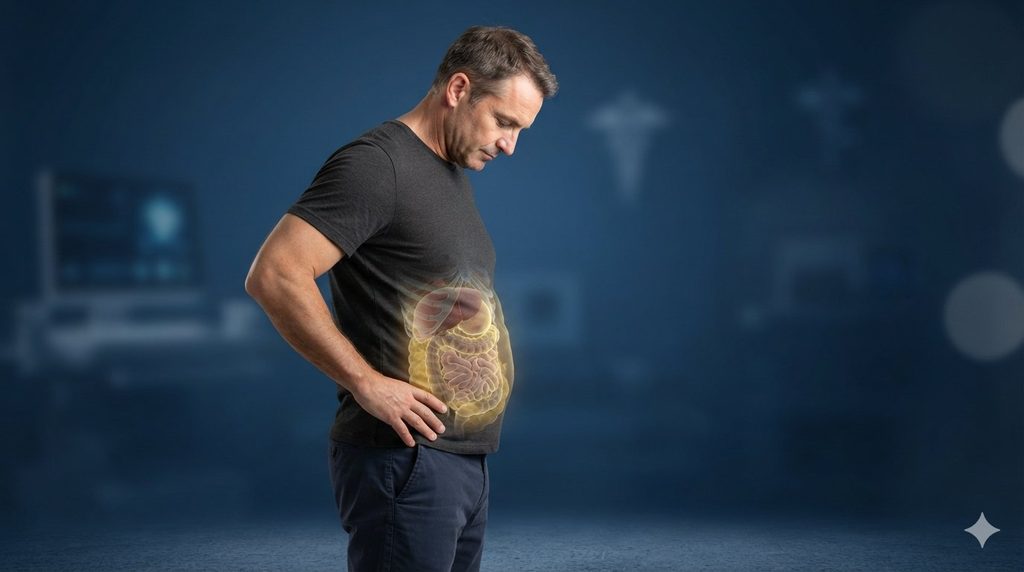
This may be one of the most encouraging parts of the story.
For many overweight men, low testosterone associated with obesity may be at least partially reversible.
Research examining weight loss interventions has repeatedly found that losing excess body weight is associated with increases in testosterone.
A 2024 review also concluded that fat reduction through approaches including dietary changes, exercise, and substantial weight loss can improve testosterone levels in men with obesity.
The Endocrine Society stated in 2026 that for appropriately diagnosed low testosterone associated with excess weight or obesity, weight loss is typically the first line approach when another underlying cause has not been identified.
That is a crucial distinction.
For some men, improving metabolic health may address part of the hormonal problem without immediately turning to testosterone replacement.
What About GLP 1 Weight Loss Medications?
This is becoming an interesting area of research.
A study presented at the Endocrine Society’s 2025 annual meeting found that men with obesity or type 2 diabetes who lost weight while using anti obesity medications also experienced significant increases in testosterone levels.
That does not mean these medications should be taken specifically to raise testosterone.
They are prescription medications used for specific medical purposes and require professional medical supervision.
But the findings support the larger point:
Improving excess body fat and metabolic health can have effects beyond the number on the scale.
The Best Place to Start: Your Waist, Not Just Your Weight
If you are trying to improve your health after 40, obsessing over the bathroom scale may not be the best strategy.
Pay attention to your waistline too.
A shrinking waist can indicate that abdominal fat is decreasing even when total body weight moves slowly.
For many men, the better goal is not simply:
Lose weight.
It is:
Lose excess fat while preserving or building muscle.
That brings us to one of the most important tools available to men over 40.
Strength Training Matters
Resistance training helps maintain muscle mass as you age.
That matters because muscle plays an important role in:
Blood sugar control
Physical strength
Metabolic health
Mobility
Body composition
Healthy aging
You do not need to train like a competitive bodybuilder.
Two or three consistent strength training sessions each week can be far more useful than occasionally destroying yourself in the gym and then quitting for three weeks.
Focus on movements that train the major muscle groups and gradually become stronger over time.
Consistency wins.
Protein Matters Too
Men trying to lose belly fat often make a mistake.
They dramatically cut calories but fail to eat enough protein or perform resistance exercise.
The scale drops, but some of the lost weight comes from muscle.
That is not the goal.
Adequate protein combined with resistance training helps support muscle while body fat is being reduced.
Foods such as:
Eggs
Fish
Chicken
Greek yogurt
Lean meat
Cottage cheese
Beans
Lentils
Can all contribute useful protein depending on your dietary preferences.
You do not need a complicated hormone boosting diet.
You need a diet you can actually maintain.
Sleep May Be More Important Than You Think
If you are eating reasonably well and exercising but sleeping five hours per night, you are making the process harder.
Sleep influences:
Appetite
Recovery
Blood sugar regulation
Exercise performance
Mood
Hormonal function
Sleep apnea deserves particular attention in men who carry excess abdominal weight.
Obesity and sleep disorders are among the medical conditions associated with hypogonadism, according to the Endocrine Society.
If you snore heavily, repeatedly wake during the night, wake with headaches, or remain exhausted despite spending enough time in bed, discuss it with your healthcare provider.
Do Testosterone Boosting Supplements Work?

This is where men need to be careful.
The supplement industry loves the testosterone problem.
Products frequently promise to:
Restore youthful testosterone
Melt belly fat
Increase muscle
Improve sexual performance
Increase energy
Sometimes all from one bottle.
Those claims deserve skepticism.
A supplement should not be used as a substitute for diagnosing the actual cause of low testosterone.
If poor sleep, obesity, diabetes, medication effects, or another medical condition is driving the problem, a bottle marketed as a testosterone booster may completely miss the real issue.
Start with the cause.
Not the marketing.
Should You Consider Testosterone Replacement Therapy?
Testosterone replacement therapy can be appropriate for some men with properly diagnosed hypogonadism.
But TRT should not be treated like a general anti aging supplement.
The Endocrine Society recommends diagnosing hypogonadism only when a man has symptoms consistent with testosterone deficiency along with clearly and repeatedly low testosterone levels.
TRT can offer meaningful benefits for appropriately selected men, but treatment also requires a discussion about potential risks, fertility, monitoring, and individual medical history.
If your only evidence of low testosterone is belly fat and fatigue, do not diagnose yourself.
Get evaluated properly.
A Practical Plan for Men Over 40
If your waistline has been growing and you are concerned about your testosterone, start with the basics.
Step 1: Measure Your Waist
Track waist circumference along with body weight.
Do it under similar conditions each time so the measurement is useful.
Step 2: Start Strength Training
Aim for consistent resistance exercise that trains the major muscle groups.
You do not need extreme workouts.
You need regular ones.
Step 3: Increase Everyday Movement
Walking is underrated.
Daily movement helps increase energy expenditure without beating up your joints or interfering with recovery.
Step 4: Prioritize Protein and Whole Foods
Build meals primarily around protein, vegetables, fruit, whole grains, legumes, and minimally processed foods.
You do not need to completely eliminate carbohydrates or fats.
Step 5: Reduce Liquid Calories and Excess Alcohol
Calories from sugary drinks and frequent alcohol can accumulate quickly without making you feel full.
Alcohol can also interfere with sleep and make healthy eating harder.
Step 6: Protect Your Sleep
Aim for consistent sleep habits and get possible sleep apnea evaluated.
Step 7: Get Medical Testing When Symptoms Justify It
If you have persistent symptoms such as low libido, erectile problems, unusual fatigue, loss of muscle, or other signs associated with testosterone deficiency, speak with a qualified healthcare professional.
The Bottom Line
Belly fat is not simply something hanging over your belt.
For men over 40, especially those carrying more fat deep inside the abdomen, it can be a sign that metabolic health is changing.
Research now suggests that visceral fat may have a stronger relationship with testosterone than body weight alone.
That is actually useful news.
It means your hormone health is not necessarily determined only by your age.
For many men, improving body composition, losing excess abdominal fat, lifting weights, sleeping better, and addressing metabolic problems may also support healthier testosterone levels.
Do not chase testosterone numbers before understanding what may be pushing them down.
Sometimes the smartest place to start is not the hormone.
It is the waistline.
Medical Disclaimer
This article is for educational purposes only and is not intended to diagnose, treat, cure, or prevent any disease. Symptoms of low testosterone can have many causes. If you are concerned about testosterone levels, sexual function, unexplained fatigue, or other health changes, speak with a qualified healthcare professional for appropriate evaluation and testing.