
The science behind age-related muscle loss, why strength matters more than appearance, and what men can do to stay strong as they get older.
There comes a point when some men begin noticing changes they never expected.
The grocery bags feel heavier. Recovering from a weekend project takes longer. A flight of stairs that once seemed effortless now requires a little more energy.
Maybe the arms and shoulders don’t look quite as muscular as they used to. Maybe the waistline has expanded, even though the number on the scale hasn’t changed much.
It’s easy to dismiss these changes as simply getting older.
But something important may be happening beneath the surface.
Muscle mass, strength, and physical performance can gradually decline as we age.
The encouraging news is that this decline is not entirely beyond our control.
Research increasingly shows that physical inactivity, inadequate nutrition, illness, and changes in how muscles respond to exercise all influence how much strength we retain.
And some of these factors can be improved.
For men over 40, protecting muscle isn’t about trying to look 25 again. It’s about maintaining the physical ability to enjoy life, stay active, and remain independent for decades to come.
What Happens to Your Muscles After 40?
Muscle is living tissue. It constantly adapts to how you use it, what you eat, and how well your body recovers.
Throughout childhood and early adulthood, muscle mass and strength generally increase. According to the National Institute on Aging, many measures of muscle performance reach their highest levels around ages 30 to 35.
After that, age-related changes may gradually begin.
However, muscle loss doesn’t suddenly accelerate on your 40th birthday.
The pace varies considerably between individuals, and more substantial declines often occur later in life.
A physically active 55-year-old man may have better strength and functional ability than a sedentary man in his 30s.
Age matters, but it does not tell the entire story.
As men grow older, several changes may occur:
- Muscle tissue can become smaller.
- Muscle strength and explosive power may decline.
- Recovery from demanding activity may take longer.
- Physical inactivity can produce noticeable losses in conditioning.
- Chronic illness and inadequate nutrition can make muscle maintenance more difficult.
The result can be gradual changes in how the body looks, moves, and performs everyday tasks.
Understanding Sarcopenia: When Muscle Loss Becomes a Health Concern
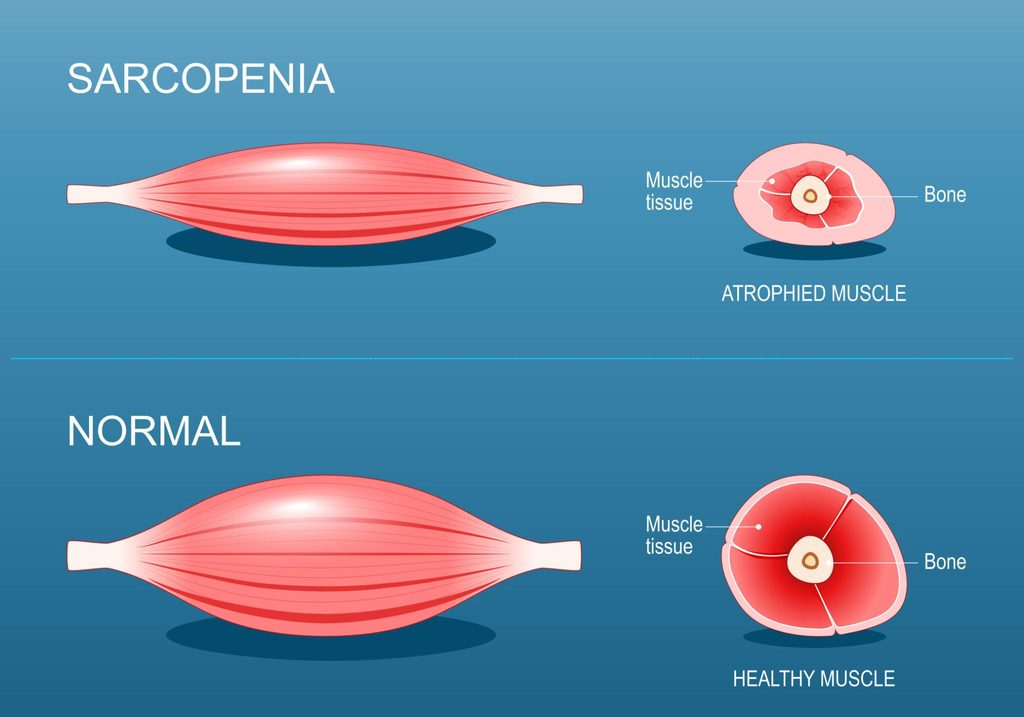
The medical term sarcopenia describes a progressive muscle disorder involving declining muscle strength and reduced muscle quantity or quality.
It is particularly important in older adults because it can affect mobility, balance, and independence.
But not every man who notices smaller arms or reduced gym performance has sarcopenia.
Clinicians generally assess muscle strength and physical performance alongside other measurements when evaluating suspected sarcopenia.
Reduced grip strength, difficulty rising from a chair, and slower walking speed may be relevant findings.
Aging is associated with muscle loss, but illness, inactivity, and inadequate nutrition can also contribute.
The key distinction is that losing muscle is not only a cosmetic issue.
Muscle supports movement, balance, glucose regulation, and the ability to perform everyday activities.
Preserving it becomes increasingly important as the years pass.
1. Your Muscles Aren’t Being Challenged Enough
One of the biggest contributors to muscle loss is also one of the most overlooked.
We stop asking our muscles to work hard.
Consider how daily life changes with age.
A man who once spent his weekends playing basketball, lifting equipment, or performing physically demanding work may gradually settle into a more sedentary routine.
More time is spent driving, working at a desk, or sitting in front of a screen.
Without regular physical challenges, the body has less reason to maintain the same level of strength.
This process is sometimes described as disuse atrophy.
Muscles adapt to the demands placed upon them. When those demands decrease, muscle tissue can shrink and strength may decline.
The solution isn’t necessarily spending two hours in a gym.
It’s providing a consistent reason for your muscles to remain strong.
Resistance training, whether performed with weights, machines, resistance bands, or body weight, can provide that stimulus.
And the evidence is encouraging.
The American College of Sports Medicine’s 2026 research review found that progressive resistance training improves muscle strength, muscle size, and multiple measures of physical function.
The lesson: Getting older doesn’t mean your muscles stop responding to exercise.
It means regular strength-building activity becomes increasingly valuable.
2. Your Muscles May Respond Differently to Protein
Protein is essential for repairing and maintaining muscle tissue.
When you eat protein-rich foods, your digestive system breaks them down into amino acids.
Your body uses those amino acids to maintain and build proteins throughout the body, including skeletal muscle.
Muscle maintenance depends partly on the balance between muscle protein synthesis, the process of building muscle proteins, and muscle protein breakdown.
With aging, muscles may become less responsive to the muscle-building signals provided by food and physical activity.
Researchers call this anabolic resistance.
It doesn’t mean your body stops using protein.
It means older muscle may require a stronger nutritional or exercise stimulus to produce a similar response.
This becomes particularly important when an older adult is eating very little protein or is recovering from illness.
Experts from the European Society for Clinical Nutrition and Metabolism have recommended approximately 1.0 to 1.2 grams of protein per kilogram of body weight daily for generally healthy older adults, particularly those over 65.
Some active people may benefit from higher intakes, depending on their needs and circumstances.
These recommendations should not be automatically applied to every man over 40. Protein needs vary with age, activity, body size, health conditions, and medical advice.
What does enough protein look like?
A balanced day might include:
- Eggs or Greek yogurt at breakfast.
- Chicken, fish, tofu, or beans at lunch.
- Lean meat, lentils, or another protein source at dinner.
- Protein-rich snacks when appropriate.
You don’t need to rely on expensive powders or supplements to eat adequate protein.
Whole foods can provide substantial amounts.
Men with kidney disease or other medical conditions should discuss protein targets with their healthcare professional before making major dietary changes.
3. Muscle Power Can Decline Before You Notice Major Muscle Loss
Muscle size and muscle strength are connected, but they are not identical.
Muscle power is another important factor.
Power describes how quickly your muscles can produce force.
Think about standing up quickly from a chair, catching yourself after stumbling, or stepping onto a high surface.
These movements depend on more than having large muscles.
They require coordination, strength, and the ability to generate force efficiently.
Research from the National Institute on Aging suggests that muscle power and performance begin declining earlier than many people realize, with more rapid declines occurring at older ages.
Changes in nerve function, muscle fibers, and neuromuscular coordination may contribute.
This is one reason simply looking muscular doesn’t guarantee good physical function.
What can help?
A well-designed exercise program should address both strength and movement quality.
For beginners, that may involve controlled squats, step-ups, and exercises that strengthen the legs and hips.
Later, when appropriate, training can include movements performed with an emphasis on controlled but purposeful speed.
Fast or explosive exercises are not suitable for everyone, particularly without experience or when balance problems are present.
The goal is to maintain the physical abilities that matter in everyday life.
4. Sitting Too Much Can Undermine Your Strength
A man might walk for 30 minutes every morning and still spend most of the remaining day sitting.
Walking is excellent for cardiovascular health and overall activity.
But walking alone may not provide enough resistance to preserve or build strength in every major muscle group.
There is an important difference between cardiovascular exercise and resistance exercise.
Walking challenges the heart, lungs, and muscles involved in locomotion.
Strength training places a more targeted demand on muscles, encouraging them to adapt and become stronger.
Both deserve a place in a healthy lifestyle.
The Centers for Disease Control and Prevention recommends that adults get at least 150 minutes of moderate-intensity aerobic activity each week, along with muscle-strengthening activities on two or more days.
For someone starting from a sedentary lifestyle, the first goal should be manageable progress rather than perfection.
A short walk after meals, taking the stairs when safe, and standing up regularly during long sitting periods can help increase daily movement.
Add structured resistance exercise, and the benefits become more complete.
5. Poor Recovery Can Make Training Less Effective
Exercise challenges muscle tissue.
Recovery provides the opportunity for adaptation.
Sleep, adequate food intake, rest, and overall health all influence how well a person responds to physical activity.
When sleep is consistently inadequate, a man may struggle with fatigue, exercise performance, mood, and motivation.
This can indirectly affect his ability to train consistently.
Chronic illness, untreated sleep disorders, and persistent stress may further complicate recovery.
However, it’s important not to blame every recovery problem on cortisol or hormones.
Sometimes the explanation is simply that a person is doing too much, too soon, without adequate rest or nutrition.
A sustainable training plan should include time between demanding sessions for the same muscle groups.
For many beginners, full-body workouts on two nonconsecutive days each week can be a sensible starting point.
The objective is to build strength over months and years, not exhaust yourself in the first week.
6. Losing Weight Too Quickly Can Also Mean Losing Muscle
Many men over 40 want to reduce belly fat.
That’s understandable, particularly when excess abdominal fat is associated with metabolic health risks.
But the way weight is lost matters.
When someone drastically restricts calories, body weight may fall quickly.
Some of that weight can come from lean tissue rather than fat.
The risk of losing muscle may be greater when rapid weight loss is combined with insufficient protein and little or no resistance training.
This is particularly relevant for men who repeatedly follow restrictive diets.
A better approach is to pursue gradual, sustainable weight loss while maintaining adequate nutrition and continuing strength training.
Resistance exercise helps provide the body with a reason to retain muscle during weight reduction.
Adequate protein also supports muscle maintenance.
The number on the bathroom scale does not reveal how much weight came from fat, muscle, or water.
For long-term health, preserving strength and function is often more important than reaching a particular number as quickly as possible.
7. Medical Conditions Can Accelerate Muscle Loss
Not all muscle loss is caused by aging or lifestyle.
Certain conditions may contribute to weakness, muscle wasting, or reduced physical activity.
Examples include:
- Chronic inflammatory diseases.
- Poorly controlled diabetes.
- Neurological conditions.
- Malnutrition.
- Prolonged illness or hospitalization.
- Some medication side effects.
- Certain hormonal disorders.
For example, extended bed rest can lead to substantial muscle deconditioning.
A person recovering from surgery or illness may notice weakness even after the original medical problem has improved.
Persistent or unexplained muscle loss should not simply be accepted as normal aging.
Sudden weakness, particularly on one side of the body, requires emergency medical assessment.
Progressive weakness, frequent falls, unexplained weight loss, or major changes in mobility warrant a medical evaluation.
What the Latest 2026 Research Says About Building Muscle
One of the most useful findings in recent strength-training research is that effective exercise doesn’t need to be unnecessarily complicated.
In April 2026, the American College of Sports Medicine published an updated position stand evaluating resistance-training research.
The review synthesized 137 systematic reviews involving more than 30,000 participants.
Researchers found that resistance training improved:
- Muscular strength.
- Muscle size.
- Muscle power.
- Muscular endurance.
- Balance and walking performance.
- Other measures of physical function.
The review also found that many different training methods can produce meaningful benefits.
Free weights, machines, resistance bands, and home-based workouts can all be useful.
Training every set until complete muscular failure was not necessary to obtain benefits.
For people who want to build more muscle, higher training volumes may offer additional improvements. But beginners do not need bodybuilding-level routines to become stronger.
The most important starting point is consistent, appropriately challenging resistance training.
That is particularly good news for busy men who have limited time.

How to Slow Muscle Loss After 40: Six Practical Strategies
1. Strength Train at Least Twice a Week
You don’t need to start with a complicated program.
A beginner-friendly full-body routine can include movements that target the legs, chest, back, shoulders, and core.
For example:
| Exercise | Beginner Starting Point |
|---|---|
| Chair squats | 1 to 2 sets of 8 to 12 |
| Wall or incline push-ups | 1 to 2 sets of 8 to 12 |
| Resistance band rows | 1 to 2 sets of 8 to 12 |
| Glute bridges | 1 to 2 sets of 10 to 12 |
| Standing calf raises | 1 to 2 sets of 10 to 15 |
| Bird dog exercise | 1 to 2 sets of 6 to 10 per side |
These are illustrative starting points, not a universal exercise prescription.
Choose movements that fit your ability, use controlled technique, and stop if an exercise causes unusual pain, dizziness, or other concerning symptoms.
A qualified trainer or physical therapist can help adjust the routine for existing injuries or mobility limitations.
2. Make Progress Gradually
Your muscles adapt to the challenges they experience.
If an exercise becomes easier, consider gradually increasing the repetitions, resistance, or number of sets.
This is called progressive overload.
It doesn’t mean lifting the heaviest weight possible.
It means making small adjustments as your strength improves.
For example, if you can perform 12 controlled wall push-ups comfortably, you might eventually move to a slightly lower incline.
Over time, these small changes can produce meaningful improvements.
3. Eat Protein Regularly
Include protein-rich foods throughout the day rather than relying on a single large protein-heavy meal.
The exact distribution is less important than meeting your overall nutritional needs, but regular meals can make adequate intake easier.
Combining sufficient protein with resistance training is a practical way to support muscle health.
4. Don’t Forget Cardiovascular Fitness
Strength and cardiovascular health work together.
Walking, cycling, swimming, and similar activities support endurance and overall health.
They also make it easier to remain physically active outside the gym.
Aim toward established physical activity recommendations, increasing gradually if you are currently inactive.
5. Protect Your Recovery
Build a regular sleep schedule, allow appropriate rest between hard training sessions, and avoid increasing exercise demands too quickly.
If fatigue is persistent despite adequate rest, discuss it with a healthcare professional.
6. Measure What You Can Actually Do
Don’t rely entirely on the bathroom scale or mirror.
Pay attention to functional improvements.
Can you climb stairs more comfortably?
Are you getting stronger at a particular exercise?
Can you carry groceries with less effort?
Are daily activities becoming easier?
These are meaningful signs of progress.
A Simple Seven-Day Strength and Activity Plan for Beginners
If you’re starting over after years of limited exercise, consistency matters more than intensity.
Here is an example week for a generally healthy beginner.
| Day | Activity |
|---|---|
| Monday | Full-body strength workout, 20 to 30 minutes |
| Tuesday | Brisk walking, 20 to 30 minutes |
| Wednesday | Light walking and mobility |
| Thursday | Full-body strength workout, 20 to 30 minutes |
| Friday | Brisk walking or cycling |
| Saturday | Comfortable recreational activity |
| Sunday | Recovery or gentle movement |
This is an introductory schedule, not a complete 150-minute aerobic exercise program. Walking sessions can be lengthened gradually as fitness improves.
The goal is to build a foundation.
A routine you can follow for six months is far more valuable than an exhausting plan you abandon after six days.
Do Men Over 40 Need Muscle-Building Supplements?
Walk through almost any supplement store and you’ll find products promising greater muscle, faster recovery, increased testosterone, and improved performance.
Some supplements have evidence supporting particular uses.
Others make claims that go well beyond the available research.
Protein powders can be convenient when someone struggles to meet protein needs through ordinary food, but they are not necessary for everyone.
Creatine monohydrate has evidence supporting improvements in strength-training performance and muscle-related outcomes in some populations when combined with exercise.
However, supplements should not replace appropriate training, nutrition, or treatment of underlying health problems.
People with kidney disease or other medical conditions should seek individualized medical advice before adding supplements.
For men starting a strength program, the priorities should remain simple:
Train consistently, eat well, recover adequately, and increase the challenge gradually.
Frequently Asked Questions
At what age do men start losing muscle?
Muscle performance often peaks during early adulthood, followed by gradual age-related changes. The timing and rate vary substantially, and declines often become more pronounced later in life. Turning 40 does not automatically cause major muscle loss.
Can a man build muscle after 50 or 60?
Yes. Research shows that many older adults can improve muscle strength and size through appropriate resistance training. The amount of improvement depends on health, training history, nutrition, and consistency.
Is walking enough to prevent muscle loss?
Walking supports health and maintains some lower-body activity, but it generally does not replace resistance training for building or preserving strength throughout the body.
How often should men over 40 lift weights?
Two or more weekly resistance-training sessions involving major muscle groups are a practical starting point for generally healthy adults. Frequency can be adjusted according to experience, goals, and recovery.
Is muscle soreness proof of a good workout?
No. Soreness may occur when you begin unfamiliar exercises, but it is not required for muscle growth or strength improvement. Progress should be judged by performance, consistency, and function.
Do men need testosterone therapy to maintain muscle?
No. Most men do not need testosterone therapy simply because they are getting older. Testosterone treatment is intended for appropriately diagnosed medical conditions and requires professional evaluation of benefits and risks.
Can lost muscle be regained?
In many cases, yes. Muscle strength and size can improve after periods of inactivity when suitable resistance training and adequate nutrition are introduced. Recovery may be limited by certain medical conditions, but meaningful functional improvement is often possible.
Final Thoughts: Strength Is Something Worth Protecting
Most men don’t think much about their muscles until something changes.
The first clue might be a heavier grocery bag, a slower climb up the stairs, or a moment when an ordinary task suddenly feels more demanding.
Those changes can be frustrating.
But they don’t have to define the decades ahead.
Muscle loss is influenced by aging, yet aging is only part of the equation.
How often you move, whether you challenge your muscles, how well you eat, and how you manage your health all make a difference.
You don’t need to become a bodybuilder.
You don’t need expensive equipment.
And you certainly don’t need to recreate the workouts you followed when you were 20.
You need a sustainable reason for your muscles to keep working.
Because the real reward of maintaining strength after 40 isn’t simply looking stronger. It’s being able to keep doing the things that make life enjoyable.
Start with two manageable strength sessions this week.
Build gradually.
And treat your strength as something worth investing in for the rest of your life.
Medical Disclaimer
This article is for educational purposes only and does not replace professional medical advice, diagnosis, or treatment. Exercise and nutritional needs vary according to health conditions, medications, physical limitations, and individual circumstances. Consult a qualified healthcare professional before beginning a new exercise program if you have significant medical conditions or unexplained weakness.
Medical References
- Currier BS, et al. (2026). American College of Sports Medicine Position Stand: Resistance Training Prescription for Muscle Function, Hypertrophy, and Physical Performance in Healthy Adults. Medicine & Science in Sports & Exercise. https://doi.org/10.1249/MSS.0000000000003897
- National Institute on Aging. How Can Strength Training Build Healthier Bodies as We Age? https://www.nia.nih.gov/news/how-can-strength-training-build-healthier-bodies-we-age
- Centers for Disease Control and Prevention. What You Can Do to Meet Physical Activity Recommendations. https://www.cdc.gov/physical-activity-basics/guidelines/index.html
- Deutz NEP, et al. (2014). Protein Intake and Exercise for Optimal Muscle Function With Aging: Recommendations From the ESPEN Expert Group. Clinical Nutrition. https://pubmed.ncbi.nlm.nih.gov/24814383/
- ESPEN. (2022). Practical Guideline: Clinical Nutrition and Hydration in Geriatrics. https://www.espen.org/files/ESPEN-Guidelines/ESPEN_practical_guideline_Clinical_nutrition_and_hydration_in_geriatrics.pdf