A billion-dollar industry is selling men false hope in capsule form. Here’s what a systematic review of 52 clinical studies actually found and what you should do instead.
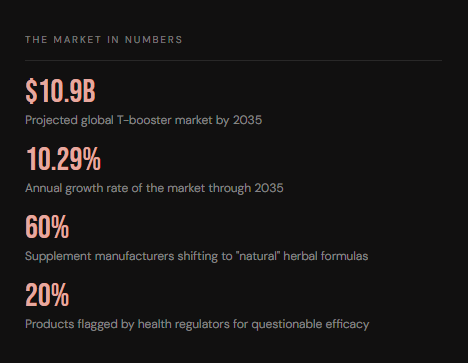
The testosterone booster market is on track to exceed $10 billion by 2035. Men are spending more on these products than ever before. And the science says most of it is wasted money — at best. At worst, it’s actively harmful.
Walk into any pharmacy, scroll through Amazon, or open any fitness app and you’ll find them, sleek black bottles promising to “reignite your drive,” “rebuild lost muscle,” and “restore your prime.” The language is calibrated to tap into something real: the anxiety many men feel about declining energy, strength, and vitality as they age. The products promise a shortcut to feeling like yourself again.
The problem is that shortcut doesn’t exist. Not in a capsule. Not at any price point.
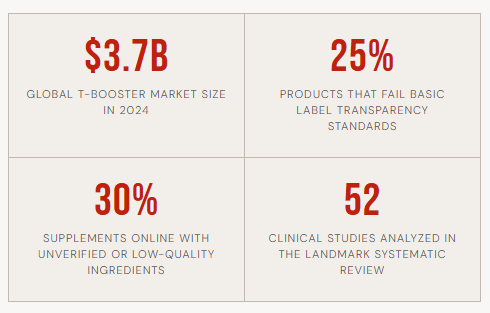
A landmark systematic review published in the International Journal of Impotence Research examined 52 clinical studies covering 27 of the most popular testosterone-boosting compounds. The researchers set out to answer one simple question: do these products actually raise testosterone? The answer, for the overwhelming majority, was no
The problem is that the shortcut doesn’t exist. Not in a capsule. Not at any price point.
A landmark systematic review published in the International Journal of Impotence Research examined 52 clinical studies covering 27 of the most popular testosterone-boosting compounds. The researchers set out to answer one simple question: do these products actually raise testosterone? The answer, for the overwhelming majority, was no
The Science
What 52 Clinical Studies Actually Found
The systematic review in the International Journal of Impotence Research is the most comprehensive analysis of testosterone booster efficacy published to date. Researchers assessed outcomes across four different populations, male athletes, healthy men, men with late-onset hypogonadism, and infertile men, and measured only one outcome: did total testosterone increase compared to the placebo?
The results were stark. Most popular ingredients showed no statistically significant effect on testosterone in healthy men. Some showed effects only in specific subpopulations, men who were already deficient, infertile, or otherwise compromised. A few ingredients had modest, context-dependent evidence. Almost none delivered what their marketing promised.
“The supplement industry knows men are desperate for T optimization — and exploits it ruthlessly.”
Here’s where it gets worse. A separate analysis published in The Journal of Sexual Medicine examined the top 50 testosterone booster supplements on Amazon and found large heterogeneity in composition, significant 30-day costs to consumers, and no strong evidence for efficacy or safety across the board. Many products relied on proprietary blends, a legal mechanism that allows manufacturers to list ingredients without disclosing individual dosages. It’s a near-perfect system for selling underdosed products while shielding the company from scrutiny.
Meanwhile, market research shows that around 30% of testosterone supplements sold online contain unverified or low-quality ingredients, and 25% fail basic label transparency standards. The FDA does not approve dietary supplements before they go to market. The burden of proof falls on regulators to prove harm after the fact, not on manufacturers to prove efficacy before sale.
INGREDIENT BY INGREDIENT
The Verdict on Every Major Ingredient
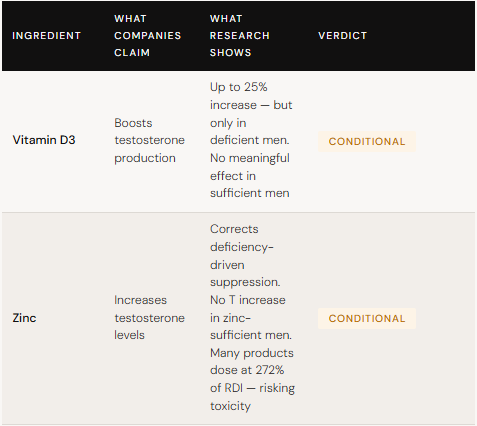
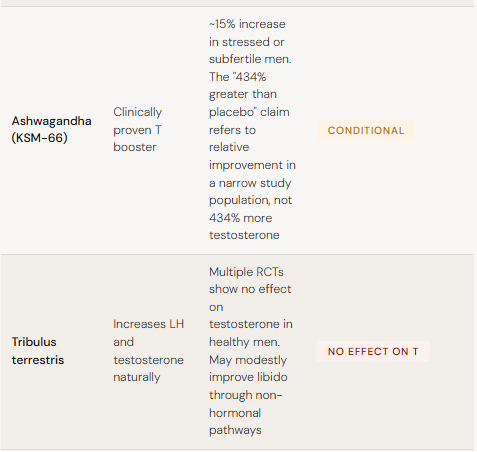
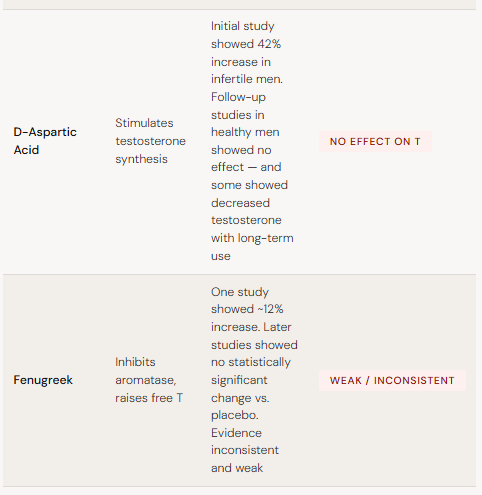
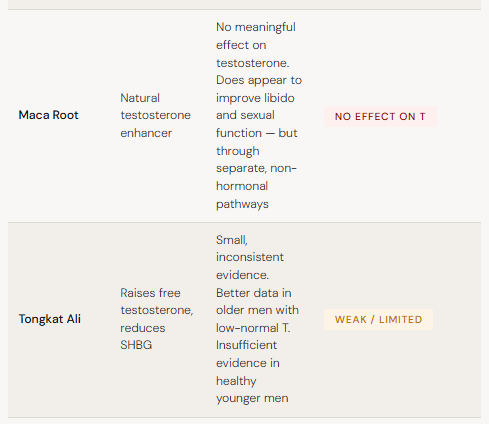
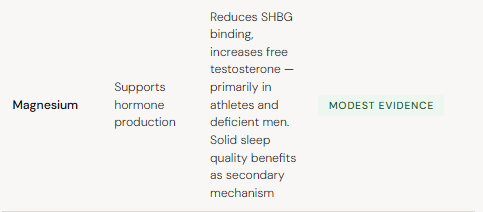
Not everything in the category is equally useless. The evidence spectrum runs from legitimate micronutrient correction all the way to pure marketing fiction. Here is what the research actually supports, broken down by compound:
THE LIBIDO CONFUSION
Many “testosterone boosters” improve libido or sexual function without actually raising testosterone. This is the single most exploited gap in consumer understanding. A man notices he feels more sexually motivated after taking a product and concludes it’s raising his T. In many cases, the ingredient is acting on dopamine, nitric oxide, or psychological pathways entirely separate from hormonal levels. The product isn’t lying about the outcome. It is absolutely lying about the mechanism.
THE BUSINESS MODEL
How a $3.7 Billion Industry Sells You Nothing
Understanding why the market persists despite the evidence requires understanding how it’s built. The testosterone booster industry operates on a model that is almost perfectly insulated from accountability.
Dietary supplements in the US are regulated under DSHEA, the Dietary Supplement Health and Education Act, a 1994 law that treats supplements more like food than medicine. Manufacturers don’t need to prove their products work before selling them. They can’t make specific disease claims, but they can make sweeping “structure/function” claims, language like “supports healthy testosterone levels,” without any clinical evidence whatsoever
Layer onto this the machinery of social media marketing. Influencer partnerships. Before-and-after testimonials that conflate unrelated lifestyle changes with supplement effects. “Clinically studied ingredients” language that cherry-picks a single compound from a multi-ingredient study and implies the whole product carries the same evidence. Proprietary blends that legally obscure the fact that each active ingredient is dosed at a fraction of the amount used in the study being cited.
Research published in a medical journal noted that supplement labeling claims routinely misappropriate scientific terminology, exaggerate findings, and misrepresent narrow research as broad evidence of efficacy. The study highlighted how a single trial conducted in men with below-average testosterone at a fertility clinic became the marketing foundation for products sold to millions of healthy men who bore no resemblance to the study population.
WHAT TO ACTUALLY DO
The Short List of Things That Work
This is not an argument that all supplements are worthless or that testosterone health is beyond influence. It’s an argument for honesty about what moves the needle, and by how much.
The research is consistent on one point: lifestyle factors have two to three times the impact on testosterone levels that supplements do. That hierarchy matters. Attempting to supplement your way out of poor sleep, chronic stress, and excess body fat is like bailing water out of a boat with a cup while the hull remains open.
Here is the condensed list of what the peer-reviewed literature actually supports:
✅ Sleep 7–9 hours. Testosterone is primarily produced during deep and REM sleep. One week of 5-hour nights reduces testosterone by 10–15% in healthy young men, the equivalent of aging a decade hormonally.
✅Lift heavy compounds. Squats, deadlifts, rows, and presses produce acute hormonal spikes and chronic improvements to body composition, the strongest dual mechanism available without a prescription.
✅ Reduce visceral fat. Adipose tissue converts testosterone to estrogen via aromatase. Even modest weight loss in overweight men reliably reverses suppressed testosterone, often without any other intervention.
✅ Test before supplementing. Vitamin D3, zinc, and magnesium show real effects, but primarily in men who are deficient. Get a blood panel first. Correcting a genuine deficiency with a targeted supplement is evidence-based. Stacking all three “just in case” is not.
✅ Manage cortisol structurally. Chronic stress chronically suppresses testosterone via the HPG axis. Ashwagandha KSM-66 has the strongest evidence among adaptogens for cortisol reduction, but only as a complement to reducing the source of stress, not as a replacement for it.
❌ Skip the branded stacks. Multi-ingredient proprietary blends with 10+ compounds at undisclosed doses are almost universally underpowered. You are paying for the branding, the marketing, and the promise, not the pharmacology.
❌ Ignore libido as a proxy for testosterone. Feeling more aroused after taking a supplement does not mean your testosterone increased. These are frequently separate pathways. Conflating them is how the industry keeps men coming back.
♦️
The hard truth is that no supplement manufacturer profits from you learning that sleep, strength training, and stress management outperform their product by a factor of two to three. The industry’s growth, projected to nearly triple by 2035, is built on keeping that information obscure.
None of this means you’re powerless. The lifestyle interventions with genuine evidence are more accessible, more sustainable, and far cheaper than a monthly supplement subscription. They require consistency rather than credit card numbers. That’s less exciting than a black bottle with bold typography. It’s also what actually works.
If you’ve done all of the above for three to six months and still experience persistent symptoms of low testosterone, chronic fatigue, significant loss of muscle mass, depressed mood, low libido, that is a medical conversation, not a supplement conversation. Seek evaluation from an endocrinologist. Clinically diagnosed hypogonadism has legitimate, FDA-reviewed treatment options. No over-the-counter product is a substitute for that.
Sources include the International Journal of Impotence Research. “Do testosterone boosters really increase serum total testosterone? A systematic review” (Nature, 2023); The Journal of Sexual Medicine. “Evidence-Based Analysis of the Top 50 Testosterone Booster Supplements on Amazon Marketplace”; Global Growth Insights. Testosterone Booster Market Analysis 2025; Spherical Insights. Testosterone Booster Supplements Market 2025–2035. Journal of the American Medical Association (sleep deprivation and testosterone); MedicalNewsToday, Testosterone Boosters Review (2025); NCBI/”PMC,” “Testosterone boosters: a report of a supplement’s misleading labeling claims.”
Disclaimer: This article is for informational and educational purposes only and does not constitute medical advice. Always consult a qualified healthcare provider before beginning or stopping any supplement or treatment protocol.