I. Introduction to Alzheimer’s Disease and Dementia
Alzheimer’s disease is a progressive, neurodegenerative brain condition that destroys brain cells, causing a slow but devastating decline in memory, thinking, and reasoning skills. It is important to understand that Alzheimer’s and dementia are not synonymous; rather, dementia is a broad umbrella term used to describe a group of symptoms caused by various disorders that damage the brain and interfere with daily life, and Alzheimer’s disease is simply the most common cause. Out of the more than 55 million people worldwide living with dementia, an estimated 60% to 70% have Alzheimer’s disease. In the United States alone, approximately 6.9 million people age 65 and older are living with the condition.
It is entirely natural to feel nervous or uncertain when you start noticing subtle changes in your own memory or the behavior of someone you deeply love. You might fear that acknowledging these cognitive slips will make them feel too “real,” or you might worry about upsetting a family member by bringing up your observations. However, ignoring these worries will not make them disappear. Dr. O’Donovan, a dementia care physician who personally cared for his own two grandmothers with Alzheimer’s, emphasizes that understanding these symptoms and seeking medical advice isn’t about jumping to the worst conclusions—it is about gaining much-needed clarity and protecting the future quality of life for you and those you love. I encourage you to keep reading to learn the critical early warning signs, because arming yourself with this knowledge is an empowering first step that can ultimately lead to earlier access to vital support, precious time to plan for the future, and life-changing treatments.
While the disease is most commonly diagnosed in individuals over the age of 65, the biological changes in the brain actually begin years, or even decades, before the first visible symptoms appear. At a biological level, the disease is driven by brain proteins that fail to function typically. Scientists largely focus on two specific proteins: beta-amyloid and tau. Beta-amyloid fragments clump together in the brain to form amyloid plaques, which severely disrupt communication between brain cells. Simultaneously, tau proteins—which normally help support a cell’s internal transport system—change their shape and organize into neurofibrillary tangles. These tangles damage cells from the inside, eventually causing the neurons to lose their connections to one another and die, leading to the physical shrinking of the brain.
The disease typically develops slowly over an average of 7 to 14 years. While historically categorized into mild, moderate, and severe stages, medical professionals now often utilize the Functional Assessment Staging Tool (FAST) Scale, which breaks the disease down into seven progressive stages ranging from normal aging to severe dementia.
II. The Key Early Warning Signs
Because Alzheimer’s disease develops insidiously, the initial symptoms are often small cognitive changes that progressively worsen. Health organizations consistently identify 10 early warning signs that individuals and their families should look out for.
1. Memory loss that disrupts daily life: The most common early symptom is short-term memory loss, which manifests as forgetting newly learned information. Individuals may frequently forget important dates, appointments, or recent conversations. They might ask the exact same questions repeatedly or increasingly rely on memory aids, like reminder notes or family members, for tasks they used to handle on their own. In the early stages, long-term memories—such as details about childhood or major life events—are typically preserved, while recent memories are impaired.
2. Challenges in planning or solving problems: People may experience a noticeable decline in their ability to develop and follow a plan or work with abstract concepts like numbers. This can look like struggling to follow a familiar recipe, such as measuring out ingredients and following steps in the correct order, or having difficulty keeping track of monthly bank statements and bills. Tasks that require concentration may take much longer to complete than they did previously.
3. Difficulty completing familiar tasks: Routine activities that have been familiar for a lifetime can suddenly become challenging. A person with early dementia may have trouble navigating and driving to a well-known location, organizing a standard grocery list, or remembering the rules of their favorite game.
4. Confusion with time or place: Individuals living with dementia can easily lose track of dates, the passage of time, or even the current season. They may become disoriented and forget where they are or how they got there, potentially becoming lost even on their own street. Furthermore, they might struggle to understand events or concepts if they are not happening immediately in the present moment.
5. Trouble understanding visual images and spatial relationships: Alzheimer’s can alter how the brain processes what the eyes see, leading to vision changes that are unrelated to typical eyesight issues like needing reading glasses. This can cause difficulty judging distances, poor depth perception, and trouble determining color or contrast. Practically, this can lead to an increase in falls due to misjudging stairs or curbs, difficulty placing items on a table, and dangerous issues when attempting to park or drive a car.
6. New problems with words in speaking or writing: Communication often becomes noticeably impaired. A person may struggle to follow or join a conversation, sometimes stopping mid-sentence with no idea how to continue, or they may repeat themselves frequently. They might also struggle with basic vocabulary, reverting to vague terms like “thing,” or substituting incorrect names for familiar objects, such as calling a “watch” a “hand-clock” or a phone a “device”.

7. Misplacing things and losing the ability to retrace steps: A person with Alzheimer’s will frequently put items in highly unusual and inappropriate places, such as placing a wallet or a TV remote in the refrigerator. Because the disease damages their short-term memory, they are unable to go back over their steps to locate lost items. As the disease progresses and things continuously go missing, they may become suspicious and begin accusing others of stealing.
8. Decreased or poor judgment: Alzheimer’s can severely affect an individual’s decision-making capabilities. This might present as spending money in highly unusual ways or using poor judgment when dealing with finances. It can also result in a lack of awareness regarding personal health and safety, such as putting off seeing a doctor for a serious medical issue, neglecting personal hygiene and bathing routines, or wearing heavy winter clothing on a hot summer day.
9. Withdrawal from work or social activities: As memory and thinking changes make following conversations and activities more difficult, a person may begin to pull away from their social life. They might abandon hobbies they have enjoyed for years, withdraw from weekly clubs, or lose interest in keeping up with a favorite sports team. This is often because the individual feels overwhelmed, confused, or embarrassed by their changing abilities, rather than simply feeling bored or lazy.
10. Changes in mood and personality: Emotional and behavioral shifts are highly common in early dementia. A person may quickly become tearful, confused, fearful, suspicious, or depressed for no obvious reason. They are also prone to becoming highly anxious or easily irritable, particularly when they are out of their comfort zone or when their typical daily routines are disrupted.
III. Differentiating Alzheimer’s from Normal Aging
It is entirely natural for memory to change slightly with age, and it is vital to differentiate between typical age-related cognitive slowing and the chronic disruption caused by dementia. Memory delay is a part of normal aging, but total memory loss is not.
Normal age-related changes involve occasional, minor lapses. For instance, temporarily forgetting a colleague’s name or an appointment but remembering it later is normal. In contrast, Alzheimer’s involves a persistent inability to recall recently learned information that actively disrupts daily life. A typical aging adult might miss a single monthly payment or make a bad decision once in a while, like forgetting to change the oil in their car. A person with Alzheimer’s, however, will experience chronic poor judgment, an ongoing inability to understand what numbers mean, and a complete inability to manage a budget.
Similarly, occasionally needing help to figure out the settings on a microwave or record a TV show is normal for an older adult. Repeatedly forgetting how to do a typical, lifelong routine like preparing a meal or getting dressed points to dementia. While anyone might temporarily misplace their keys and have to retrace their steps to find them, placing keys in the refrigerator and being entirely unable to retrace steps is a stark warning sign. Finally, sometimes having trouble finding the exact right word in a conversation is a normal part of aging; substituting nonsensical words or frequently stopping mid-sentence is a symptom of cognitive decline.
IV. Risk Factors and Prevention
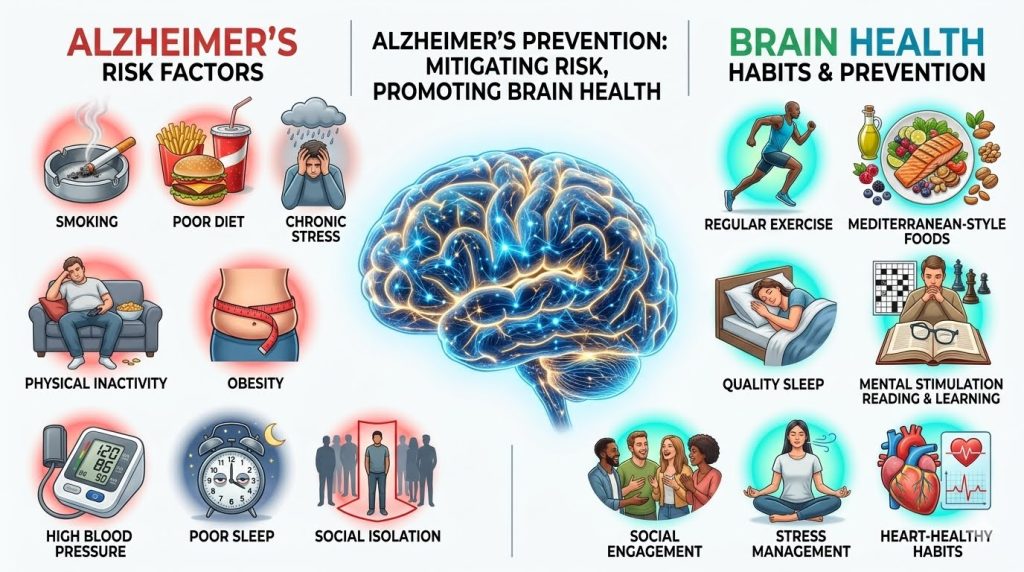
While Alzheimer’s is not a typical part of aging, older age remains the strongest known risk factor for developing the disease. The likelihood of being diagnosed increases significantly as individuals grow older. Beyond age, family history and genetics play a complex role; having a first-degree relative with Alzheimer’s increases your risk. Specifically, inheriting a form of the apolipoprotein E gene known as APOE e4 raises the risk, though it does not guarantee the disease will develop. Additionally, people with Down syndrome are at a high risk of developing Alzheimer’s—often 10 to 20 years earlier than the general population—likely due to having three copies of chromosome 21, which is involved in beta-amyloid production.
There are also numerous health and environmental factors that elevate the risk. Experiencing a serious traumatic brain injury (TBI) or multiple TBIs can increase the likelihood of developing dementia. Environmental hazards, such as exposure to air pollution from traffic exhaust and burning wood, have also been linked to a higher risk. Furthermore, heavy alcohol use, poor sleep patterns (including sleep apnea), and untreated vision or hearing loss are all significant risk factors. Finally, a lack of lifelong learning and social engagement, or having a low education level, can leave the brain more vulnerable to cognitive decline.
Although there is no definitive way to prevent Alzheimer’s disease, making proactive lifestyle choices can significantly lower your risk. Managing cardiovascular health is paramount, as the same factors that cause heart disease—such as high blood pressure, high LDL cholesterol, obesity, smoking, and poorly managed type 2 diabetes—also raise the risk of dementia. To protect your brain, experts recommend engaging in regular physical exercise and eating a heart-healthy diet. The Mediterranean diet, which focuses on plant-based foods, fruits, vegetables, grains, fish, nuts, and olive oil while limiting saturated and trans fats, has been shown to lead to better cognitive function and a slower rate of cognitive decline. Additionally, staying socially and mentally active throughout life by reading, dancing, playing instruments, and participating in social events can help preserve thinking skills and build cognitive resilience.
V. Diagnosis and Medical Action
If you notice sudden or persistent warning signs in yourself or a loved one, it is critical to schedule a professional medical evaluation rather than ignoring the symptoms. Do not jump to conclusions, but do take action to gain clarity. Memory problems can be caused by a variety of conditions, some of which are entirely reversible, such as severe stress, depression, vitamin deficiencies, infections, or medication side effects.
To achieve an accurate diagnosis, doctors will first evaluate the patient’s symptoms, the timeline of changes, and how those changes impact their daily independence. Medical professionals utilize a variety of diagnostic tools, including cognitive and neuropsychological tests that evaluate short- and long-term memory, executive functioning, attention, and language skills. They will also conduct blood tests to look for disease markers and rule out reversible causes. To confirm the presence of Alzheimer’s, doctors often utilize brain scans—such as CT, MRI, and PET scans—to evaluate changes in brain matter, rule out strokes or tumors, and definitively identify the disease, sometimes alongside spinal fluid tests.
While there is currently no cure for Alzheimer’s disease, early detection provides life-changing benefits. Diagnosing the disease in its early stages allows individuals access to new FDA-approved treatments and medications—such as lecanemab and donanemab—which can help manage symptoms and effectively slow the progression of cognitive decline. Slower progression means individuals can maintain a higher quality of life and retain their independence for a longer period. Furthermore, an early diagnosis provides the individual and their family with precious time to process the news, set realistic expectations, participate in clinical trials, and proactively plan for future caregiving and financial needs.
