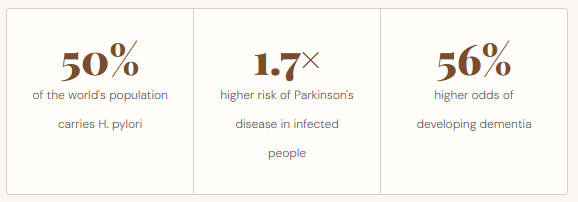
You’ve probably never thought about the tiny spiral-shaped bacteria living in your stomach right now. But there’s a good chance they’re there. Helicobacter pylori — called H. pylori for short — infects roughly half the people on Earth. Most of the time, it hangs around quietly, causing nothing more than a bit of indigestion. But new research is uncovering something genuinely unsettling: this stomach bug may be quietly messing with your brain.
Not in a science-fiction way. In a very real, biological way that scientists are only now beginning to fully understand. If you’ve been dealing with brain fog, anxiety, depression, or unexplained memory problems on top of digestive issues — this might be worth reading carefully.
What Is H. Pylori, Really?
H. pylori is a type of bacteria that loves to set up camp in the lining of your stomach. It’s been doing this for tens of thousands of years — scientists think early humans picked it up in Africa and carried it with them as they spread across the globe. Today it’s especially common in places with limited access to clean water, but it affects people everywhere, rich or poor.
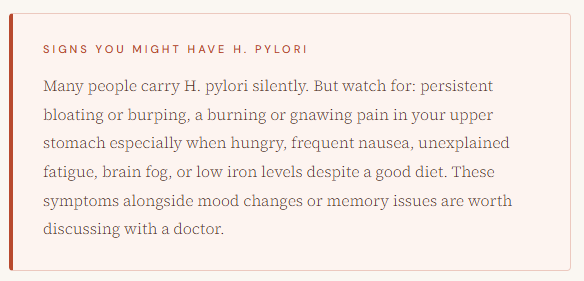
Most people get it in childhood, often without knowing it. Contaminated food and water are the usual routes. And here’s the tricky part: about 80% of people who carry it never feel a single symptom. No pain, no nausea, nothing. That silence is exactly what makes it so sneaky.
The ones who do feel it know it well — burning stomach pain, bloating, nausea, a constant feeling that something isn’t right after meals. Long-term, H. pylori is the leading cause of stomach ulcers and a significant driver of stomach cancer. But those are the gut problems. What scientists discovered recently is that the trouble doesn’t stay put.
—————————————————The Connection———————————————–
The Highway Between Your Gut and Your Brain
Here’s something most people don’t learn in school: your gut and your brain are in constant conversation. There’s an entire communication system connecting them called the gut-brain axis, and it runs in both directions. Your brain sends signals to your gut (that’s why you get butterflies when you’re nervous), and your gut sends signals right back up to your brain.
This isn’t just nerves talking to each other. It’s hormones, immune chemicals, and trillions of bacteria — your gut microbiome — all participating in one giant conversation that affects your mood, your memory, and how clearly you think.
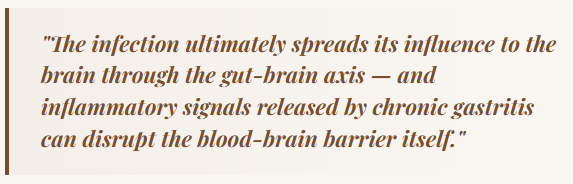
When H. pylori moves in, it disrupts this whole conversation. It doesn’t just irritate your stomach lining. It releases toxic proteins — two of the nastiest are called CagA and VacA — that trigger a cascade of inflammation. That inflammation doesn’t stay in your gut. It gets into your bloodstream, travels to your brain, and starts causing problems up there too.
THE BLOOD-BRAIN BARRIER PROBLEM
Your brain has a protective fence around it called the blood-brain barrier. Think of it like a bouncer at a club — it keeps dangerous things out. But when H. pylori causes chronic gut inflammation, it weakens this barrier. A 2025 study published in bioRxiv found that proteins released by H. pylori infection actually break down critical proteins that hold the blood-brain barrier together, making it leaky. Once that fence is compromised, inflammatory molecules can slip into the brain and start causing damage.
The result? Neuroinflammation — which is basically your brain being inflamed and under stress. And chronic brain inflammation is something scientists now link to depression, anxiety, cognitive decline, and several major neurological diseases.
—————————————————–THE RESEARCH———————————————
What the Latest Science Is Finding
This isn’t fringe research. A sweeping 2025 meta-analysis published in Frontiers in Medicine reviewed 41 studies involving over 159,000 participants. The findings were hard to ignore.
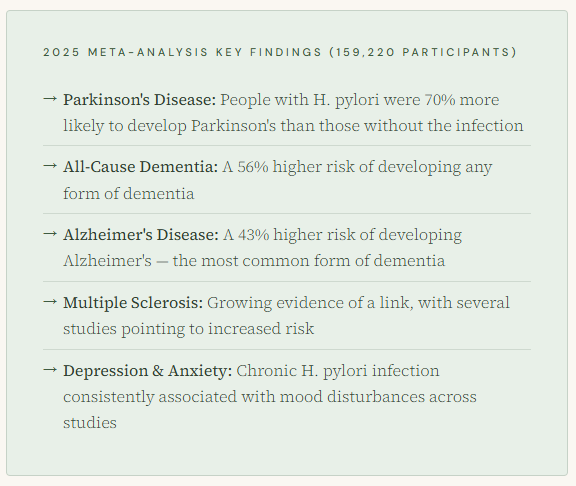
A 2024 study in the journal Virulence drilled down even deeper. Researchers found that proteins secreted by H. pylori directly affect neuronal cells — the cells in your brain — by activating a pathway called STAT3. When STAT3 gets turned on too much, it ramps up the proteins associated with Alzheimer’s disease, including amyloid and APOE4. In plain language: a stomach infection appears to be able to flip the switches that eventually lead to memory loss.
And it gets more personal than just disease risk. H. pylori infection scrambles the signals that regulate hunger hormones like ghrelin and leptin, which directly communicate with your brain. This explains why so many people with H. pylori feel a strange kind of early fullness, or have unpredictable appetite changes — their gut is sending the wrong messages upstairs.
THE VITAMIN B12 FACTOR YOU NEED TO KNOW
There’s one more way H. pylori harms your brain that doesn’t get talked about enough: it interferes with your ability to absorb vitamin B12. This matters enormously because B12 is essential for nerve health and brain function. Without enough of it, you can experience brain fog, poor memory, mood changes, and fatigue. Many people struggling with these symptoms have never been tested for H. pylori — or for B12 deficiency — even though the two are closely linked.
—————————————————-NATURAL SUPPORT—————————————————-
How to Support Your Gut-Brain Axis Naturally
First, the honest part: if you have a confirmed H. pylori infection, the standard medical treatment — a short course of antibiotics plus a proton pump inhibitor — is still the most reliable way to eradicate it. Don’t skip that conversation with your doctor. But natural approaches can play a powerful supporting role, both during and after treatment, and for protecting your gut-brain axis in general.
1. BROCCOLI SPROUTS — NATURE’S H. PYLORI FIGTHER
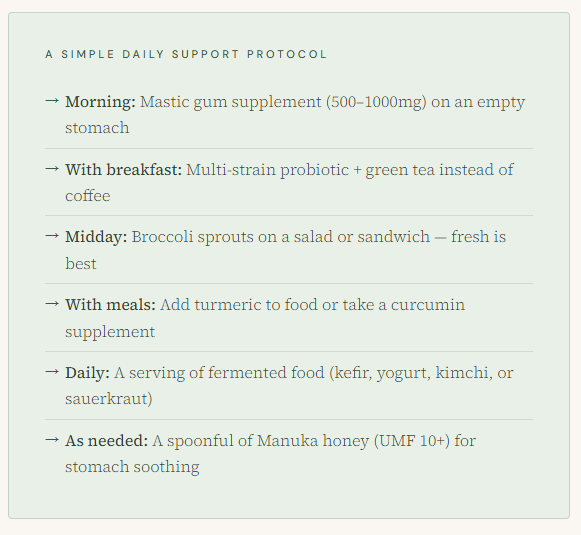
Broccoli sprouts contain a compound called sulforaphane that has shown real promise against H. pylori. Human studies have found that eating them daily reduced bacterial colonization and gastric inflammation. One study found a 78% reduction rate in people who ate broccoli sprouts twice a day for a week. Fresh sprouts contain significantly higher levels of sulforaphane than mature broccoli — aim for about 70 grams a day if you’re actively dealing with an infection.
2. PROBIOTICS — RESTORE THE GUT ARMY
One of the biggest ways H. pylori disrupts the gut-brain axis is by throwing off the balance of your gut microbiome. Probiotics — especially strains from the Lactobacillus and Bifidobacterium families — can help restore balance. A 2024 analysis of 534 randomized clinical trials found that multi-strain probiotics significantly improved H. pylori eradication rates and also reduced the nasty side effects of antibiotic treatment. They also directly support the gut-brain axis by producing calming neurotransmitter precursors like serotonin — yes, most of your serotonin is actually made in your gut, not your brain.
3. MASTIC GUM — ANCIENTt REMEDY WITH MODERNn PROOF
Mastic gum is a resin tapped from pistachio trees on the Greek island of Chios, and it has been used as a digestive remedy for centuries. Modern research has confirmed why: it contains natural antimicrobial compounds that inhibit H. pylori growth. Studies have shown benefits at doses as low as 1mg per day over a few weeks. It also helps soothe the stomach lining and can support healing of ulcers caused by the bacteria.
4. FERMENTED FOODS — FEED THE GOOD BUGS
Sauerkraut, kimchi, kefir, and plain yogurt all contain lactic acid bacteria that compete with H. pylori in your gut. These fermented foods also produce short-chain fatty acids — chemical signals that travel through the gut-brain axis and have been shown to reduce brain inflammation and support healthy mood. Think of them as cheap, daily maintenance for your gut-brain connection.
5. MANUKA HONEY — SWEET, POTENTt, AND RESEARCH-BASED
Not all honey is created equal. Manuka honey, produced in New Zealand, has documented antibacterial effects against H. pylori. Look for a UMF (Unique Manuka Factor) rating of at least 10+ for therapeutic purposes. While it likely can’t eradicate H. pylori on its own, it works well as part of a broader natural protocol, especially at soothing an inflamed stomach lining in the meantime.
6. GREEN TEA & CURCUMIN — CALM THE BRAIN FIRE
Beyond fighting the bacteria itself, remember that a lot of the brain damage H. pylori causes comes from inflammation. Green tea (EGCG) and curcumin from turmeric are two of the most studied natural anti-inflammatories. Both cross into the brain and help reduce neuroinflammation. They won’t eradicate H. pylori alone, but as part of a daily routine, they help protect your brain while you work on healing your gut.
The Bottom Line
H. pylori has been living inside humans for so long that most of us have stopped thinking of it as a threat. But the evidence building up in research labs around the world tells a different story. This bacteria doesn’t just sit quietly in your stomach — it tugs on the invisible threads connecting your gut to your brain, quietly raising your risk of depression, cognitive decline, and even Alzheimer’s and Parkinson’s disease.
The good news? Your gut-brain axis is not a one-way street. You have real power to support it. Whether it’s loading up on broccoli sprouts and fermented foods, getting tested and treated if needed, or simply paying more attention to the connection between your stomach and your state of mind — small, consistent steps add up to real protection.
Your gut and your brain are on the same team. It’s time to start feeding them both like it.
As always, talk to your healthcare provider before starting any new supplement protocol, especially if you suspect an active H. pylori infection. This article is for educational purposes and reflects the most current available research as of April 2026.
This post is for informational purposes only and does not constitute medical advice. Always consult a qualified healthcare professional for diagnosis and treatment of any health condition. Sources include: Frontiers in Medicine (2025), Virulence (2024), bioRxiv (2025), Molecular Neurobiology (2025), ScienceDirect (2024), and clinical review literature.